Sabtu, 04 Juni 2011

How to Load SHP file with Maestro MapGuide 3.0

Run  MapGuide Maestro, menu will appear to log on to the MapGuide Server:
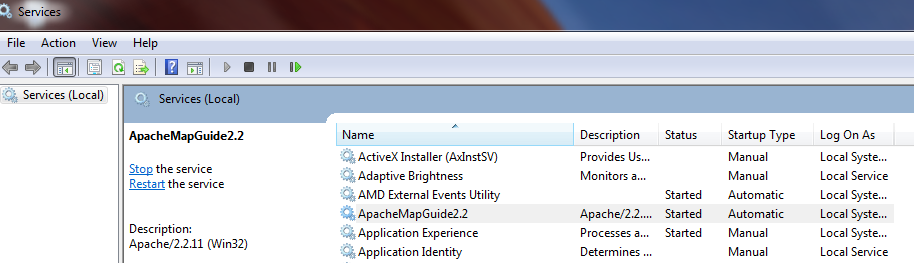
Enter Username = Administrator password = admin and do like the image above click the OK button If you fail, the check in window service, especially on the ApacheMapGuide server:( Windows 7)
And also on the MapGuide Server in the Start state 


Keep in mind you do not turn on IIS server or other server applications to avoid failure If you managed to Log On to the Maestro 3.0 looks like below
MapGuide on http://localhost:8008/Mapguide (test) address Just how you add in New Resource by Click  

In a more complete Maestro 3.0 from Maestro 2.0 because there are facilities  , Load DWF files, SHP files, SDF files will certainly help in entering data spatial into the MapGuide  Sample Load SHP files we will do with New Resources, select SHP Load Procedure  as the picture above input file  Add existing files to your computer:


You drag until you find the Transformation means SHP files you will follow a certain coordinat system choose to click the button ;  follow   on-screen display command to select the coordinate system  
After all done, your search drag Load Settings, Select the folder you use to put the file and press  Load SHP Resources
Further Resources in setting the layer to check the layer properties which appear later in the Style layer on the display area Click On Button Rule and a window menu associated with the layer display
Good luck

Jumat, 03 Juni 2011

Rituals Ceremony " Ngelmu" of Java's mystics

In ngesthi some people do rituals related to food and drink that sharp intuition, keen desire and also creates a void:
  1. MELEK No sleep last night not to be out overnight room away, cannot lay down sustenance.
  2. MUTIH  40 days only eat white rice and drink water a little at a time when the sun sets.
  3. NGEBLENG that is not out of room on the day last night, no lights, just come out when pee, should not be sleeping, eating and drinking
  4. NGLOWONG only eat certain with time-specific sleep only 3 hours
  5. NGROWOT must only eat one type of fruit of a maximum of 3 fruit from dawn until sunset.
  6.  NGANYEB may eat any but there is no taste 
  7.  NGIDANG must only drink water and leaves. Others may not.
  8.  NGEPEL only eat rice a day a fist up to 3 of the fist 
  9.  NGALONG, fasting ngrowot while hanging in trees with the position of the foot above the head under (such as a bat) doing this.
  10.  KUMKUM i.e. fasting cross-legged in a see two River currents are too start hour 12 night until 3 or 4 hours of the morning.
  11. PENDEM  i.e. fasting buried alive only   breath, usually for   7 days,

There is an expert in Javanese culture. He has been a role model "ngelmu" Java argues:
Don't you blackouts so. Especially when you are done with a very aggressive to achieve outside of common sense.
Indeed that is the ritual that is often executed but all I can say is a hoax. After you can finish it you won't get anything ...
You can benefit if you have been able to encapsulate all into something awareness of thought. Don't you think by carrying out ritual enough. You must have the intelligence to understand it all. And all that exists in the Mind
The end of doing a ritual some supernatural benefits can be obtained:
  • Not visible to human eyes
  • Immune to the sharp weapon
  • Can see jin Devil dar evil spirits
  • Strong characters

In Ngesthi : A sense of the body, the soul, beliefs, desires and completeness of the human senses, as well as to United cooking. Then became the symbol of the mind with its attributes

Kamis, 02 Juni 2011

The word "ora ilok" a laws norm Javanese ?

The Javanese are the largest ethnic group in Indonesia who came from Central Java, East Java, and Yogyakarta. At least 41.7% of Indonesia's population is ethnically Javanese. In addition to the three provinces, many Javanese living in Lampung, Banten, Jakarta and North Sumatra, Suriname. In West Java they are found in Indramayu district and Cirebon. Java tribe also has a sub-tribe, such as Osing and Tengger.

Culture provides the values ​​to the social norms so that cultural   ​​are working to   the social system resources. Culture can be seen its role in social processes in society. This is the motivation I deliver this article, in order to explore the values ​​that exist in the Javanese culture
 ora ilok is very thick with the advice of parents to their children or younger as though if we do   have  a sin or     sin half.

Ora ilok are words often heard in the Java community ..... even if the person is already violated or conduct must in ruwat that now many who encountered a  ritual ceremony ... Basically ora ilok ? of course people were not able to declare the reasons bluntly, because the norm "ora ilok ..".

 Authors observed any relation with the "behavior" is a kind of ritual ngelmu or beliefs of a large family.

if you eat foods such as blowing, watering luweng finished cooking, leave the rice is just cooked, do not go fit repetition day of death  your parents, do not leave a broom  regel , etc.
some form of lelakon: ontang anting ( one kid), Pendowo limo (five kids),   born wrapped in placenta and so forth
partly because of the time: open the door at sunset, was born when the sun was right at 12 o'clock or so on top
partly because it did not intentionally, throw salt, throw garbage through the window, throwing   washing water of  rice in washtafel and so on ..

This is the result of feedback from visitors:

  1.     Planting bamboo not have the son kid
  2.     Not segmented bamboo pieces are not broken down
  3.     Stabbing, a weapon into the earth 
  4.     Ngekrek blarak nyasak (?)
  5.     Burning a rusty weapon
  6.     Patted the pillow when going to bed
  7.     Wipe the table with your palms
  8.     Wood burning cottonwoods, moringa tree, the tree crushed
  9.     Insert a wood fire to luweng with leg  
  10.     Make a well of water in the house
  11.     Planting a banana tree in the front yard
  12.     Eating sajen not been terminated
  13.     Login tomb complex disposable footwear
  14.     Umbrella leaf Breadnut
  15.     Umbrellas do not cut banana leaf bud
  16.     Patil carelessly dumped catfish
  17.     Pointing with his tomb complex
  18.     Directly mention the name of the deceased
  19.     Small children eat rice crust
  20.     Small children eat meat chicken, wings
  21.     New pan- not diumbul
  22.     Blowing fire in the lantern
  23.     Using a back hoe sun
  24.     Creating a home without windows
  25.     Men see rice storage
  26.     Cut down the banana tree is not complete
  27.     Harvest is not made ceremony
  28.     Harvesting chili fit (mens)
  29.     Burn the hair, nails
  30.     Create a cot from jackfruit wood
  31.     People close pregnant ant nest
  32.     Cutting bamboo fitted initial date (the date of the month)
  33.     Burning clothes
  34.     Discard the broken pot carelessly
  35.     Diamond leaf extract for who could not make it
  36.     Discard the hot water any place
  37.     Planting does not have black sticky-law
  38.     Small children should not eat bananas edges
  39.     Pillow to sleep occupied
  40.     Pole or stepping over people sleeping
  41.     Lend money at night
  42.     Taking the former home of the wood to build homes
  43.     Taking goods / objects from the tomb to be placed in homes
  44.     Neighbors see our granary
  45.     Was eating his plate lap
  46.     By the name of the banana flower
  47.     Chop some wit pumpkin
  48.     Girls whistling
  49.     Collecting fireflies
  50.     Burning leaves Breadnut
  51.     Burn the black sticky rice husks indiscriminate
  52.     Making a bamboo ladder not have children / in-law
  53.     Creating a home base with its pillar without
  54.     Burn rust or salt
  55.     Ash from luweng continue to be used for fertilizer
  56.     Eating meat raven (crow)
  57.     Burning feathers bat / bats
  58.     Tree binding
  59.     Make golong not immediately broken down
  60.     chin support
  61.     Build preliminaries sunrise
  62.     Planting jackfruit tree near the house
  63.     Leaving drinks, hot rice to cool on its own
  64.     Sleeping mat teak leaves
  65.     Leave the grain in a mortar until the evening
  66.     Cutting down trees is not tied
  67.     Blowing hot rice
golong = rice make the ball
diumbuli = make ready with mantra,praying secret
blarak = leaf coconut

Sensory

What can be explained for Five senses ?

  1. Smell can find something of unknown origin but we can recognize the existence of an object
  2. Hearing may know the distance of an object. some things can be measured far and near
  3. Taste to find and sort out the matter even though it is mixed with other objects
  4. Visual to describe the appearance of an object, including large and small
  5. Hand to know the nature and existence of real objects.
Five senses can not be separated in the development of the user. Information from outside our bodies will all be one consciousness recorded in the mind.
This process is often considered unusual because it can happen in a day hundreds of thousands of times.

If you memorize it and have become conscious of thought and then you create a symbol for it then can be transferred for others.
Here's a few of the use of symbols associated with the thinking

In the culture of everyday Java people do not get out of the use of symbols which is a form of consciousness

  • seven flower colors mean awareness of the use seven days a week
  • Janur means to silence
  • wood (Kajeng) means a form of desire
  • stone base deeds mean firmness
  • mean water flow in the form of science nor supernatural talents of descent
etc.